Automated Biliary Segmentation for PTBD
Patients with obstructive jaundice often can't continue chemotherapy until their bilirubin comes down, and percutaneous transhepatic biliary drainage (PTBD) is the usual way to get there. But there are no clear guidelines on which patients, by biliary anatomy, benefit most. Quantifying how dilated the bile ducts are could help select them. This study built an automated segmentation model for that. I was first author on the RSNA abstract.
Data and models
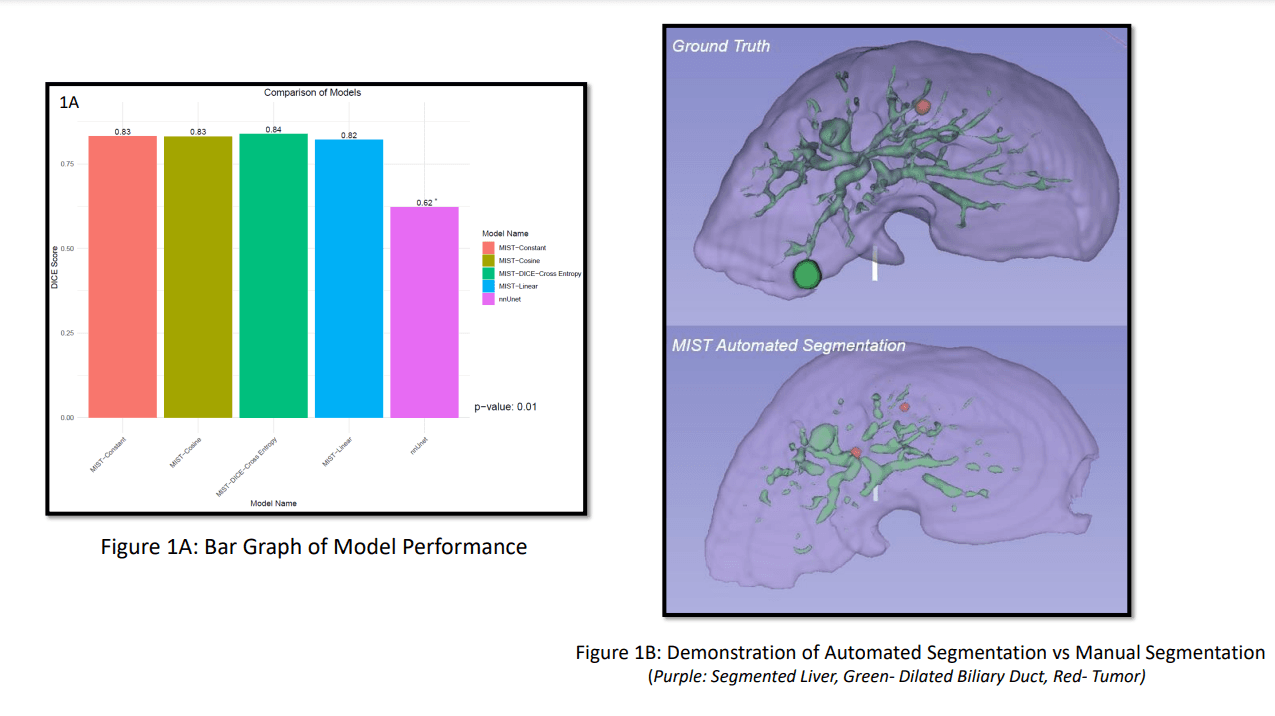
A single-institution retrospective set of PTBD patients from January 2016 to May 2024 with pre- and post-procedure CT, giving 89 cases with ground-truth segmentations from an interventional radiologist (56 training, 33 validation). Five models were trained with identical settings: nnU-Net and four MIST variants differing in loss (Dice cross-entropy, and clDice with constant, linear and cosine schedules). Mean Dice scores were compared with ANOVA.
Results
| Model | Dice |
|---|---|
| MIST, Dice cross-entropy | 0.8379 |
| MIST, clDice constant | 0.8313 |
| MIST, clDice cosine | 0.8307 |
| MIST, clDice linear | 0.8206 |
| nnU-Net | 0.6215 |
The MIST models scored well above nnU-Net, a significant difference by ANOVA (p = 0.01).
Limitations
One institution and 89 cases, with a single annotator, so the results still need external validation before they can guide patient selection.